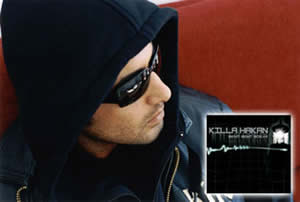
Detailed information about Aziz A, Muhabbet, and Kool Savaş has also been included…. KillaHakan -If I asked you to describe how you make music to someone you've never met before…
Killa Hakan: I mix hip hop with oriental melodies and add Turkish lyrics. My friends from America and Europe accompany me on some of my songs. -How many albums have you released? "Semt semt sokak" (Street by Street, Neighborhood) - which album is that?
Killa Hakan: I first joined the group Islamic Force in 1994 through its founder Boe b. (Bülent İpek). In 1997, I was featured on their album "Mesaj". In 2001, my first solo album, "Çakallar," was released. In 2003, I made the album "Rapüstad" with Fuat. I gained recognition by composing music for documentary films. I wrote a song for the film "O Şimdi Mahkum" (He is Now a Prisoner). Last week, my solo album "Semt Semt Sokak" (Street by Neighborhood) was released both in Türkiye and Germany. -What kind of album is "Neighborhood by Neighborhood Street"?
Killa Hakan: We try to improve our sound with every album. In the past, it was very rare to find Turkish singers performing this type of music. But we've gotten people used to it with the quality of our work. Major magazines in Germany dedicated significant space to the album. -Is it more difficult or easier to make music as a Turk in Germany?
Killa Hakan: It's great... You get the opportunity to work with very good musicians. The reactions are generally positive. There are some who don't understand because of the Turkish lyrics, so we tell them to contact their Turkish neighbors downstairs. This is something that brings the two cultures closer together. -Why don't you write the lyrics in German? Wouldn't that reach both Turks and Germans there?
Killa Hakan: Yes, if I wrote lyrics in German, I would definitely reach and be heard by more people. But we've been fighting for Turkish rap since the mid-90s, and we want to be listened to not only in Germany but also in Türkiye. -In recent years, third-generation Turks in Germany have achieved great success. In your opinion, how have these successes affected the image of Turks in the eyes of Germans?
Killa Hakan: First of all, we make music that's different from musicians in Türkiye. Whether it's pop, arabesque, or rap, we've created a style that people in Turkey call "Almancı" (German-Turkish). We didn't just introduce döner kebab and yogurt to Europeans; we also introduced Turkish melodies and other parts of our culture. After a rapper who has no connection to Turkey listens to our music, they start looking at Turks differently. We make our own music in Germany, and we call it Turkish Music Made in Germany. -If you were German instead of Turkish, would things have been different? Would you have risen to prominence faster then?
Killa Hakan: I don't see it as a disadvantage. I can say that our story has just begun here. We still have a lot to tell. However, I think the Europeans' story is over. They've started repeating where they were. I think Europe needs the Turks very much. -Which culture do you feel closer to?
Killa Hakan: I know both cultures well, I'm close to both. If you ask me where I feel at home, it's only in my own neighborhood. Limited to an area of 5 square kilometers… -How are your relations with Turkey?
Killa Hakan: Most of my relatives live in Türkiye. We used to go there very often, but it's become less frequent now. Hopefully, I'll give more concerts there so our relationships can be strengthened again. Kool War(31)
According to Focus magazine, he's Germany's Eminem.
His real name is Savaş Yurderi. Born in Germany, his father is Turkish and his mother is German. He has lived in Germany since 1981. Focus magazine describes Savaş, a rap musician, as "Germany's Eminem." Kool Savaş is one of the musicians who rose to fame with his first album. He writes his lyrics in German. Many music critics claim that he has brought fluency to the German language. Yurderi, who doesn't shy away from using slang, generally talks about the problems young people face with their families and schools in his songs. In an interview published in Hürriyet Pazar some time ago, Kool Savaş said, "There are many Turks in the art world in Germany because Turkish children grew up here. But I think it's wrong to try to define the work done today as only Turkish or German. The art made here is a part of this place. I think everyone here is a part of German culture." Love(21)
The song first spread on the internet…
Muhabbet, whose real name is Murat Erşen, is only 21 years old. He recently finished vocational school and is about to enter university. His grandfather came to Germany in the 1960s. He is a third-generation immigrant, born and raised there. A year and a half ago, he made a song and released it online. The song quickly went viral, being downloaded 250,000 times. His fame skyrocketed. Now he's busy preparing his first album, which will be released in November. "I make German-language arabesque music," he says. "The lyrics are in German, but the melodies are arabesque, and the background music is R&B; this is particularly appealing to the new generation growing up in Germany." His record producer, Ünal Yüksel, points out another aspect: "In the past, when a German and a Turkish couple separated, the German would listen to their own music. Now, with his songs, for the first time, Germans and Turks will have shared love and breakup songs!" Aziza A(35)
Oriental hip-hop artist to release third album…
Aziza, whose real name is Alev Yıldırım, was one of the first musicians to become famous in Germany. Born in Berlin in 1971, she began hosting the children's program Dr. Mag, which aired every Saturday on the ZDF television channel in 1996. Unlike her parents, who returned permanently to Türkiye in 1999, she stayed in Berlin with her older brother. Her first album, Es ist Zeit (It's Time), was released in 1997. She was chosen as one of the hundred most important people of the year by Zitty magazine, published in Berlin, as "the first Turkish girl to do hip-hop in Germany." Following this, she appeared in various fields, including a radio show, a small role in Kutluğ Ataman's film Lola and Bilidikid, and acting in a film made for ZDF in 1999. She gave an opening concert at the German pavilion at Expo 2000. Her role in the play Kopstoff, adapted for the theater by writer Feridun Zaimoğlu, was also widely discussed. Aziza, who released her second album "My Own World" in Türkiye in 2001 under the Doublemoon label, creates music that blends funk, soul, jazz, and R&B, rooted in the streets. She is currently in Germany preparing her third album…
Röportajda Yer Alan Sanatçılar
Aziza A.
Killa Hakan
Kool Savaş
Muhabbet
|